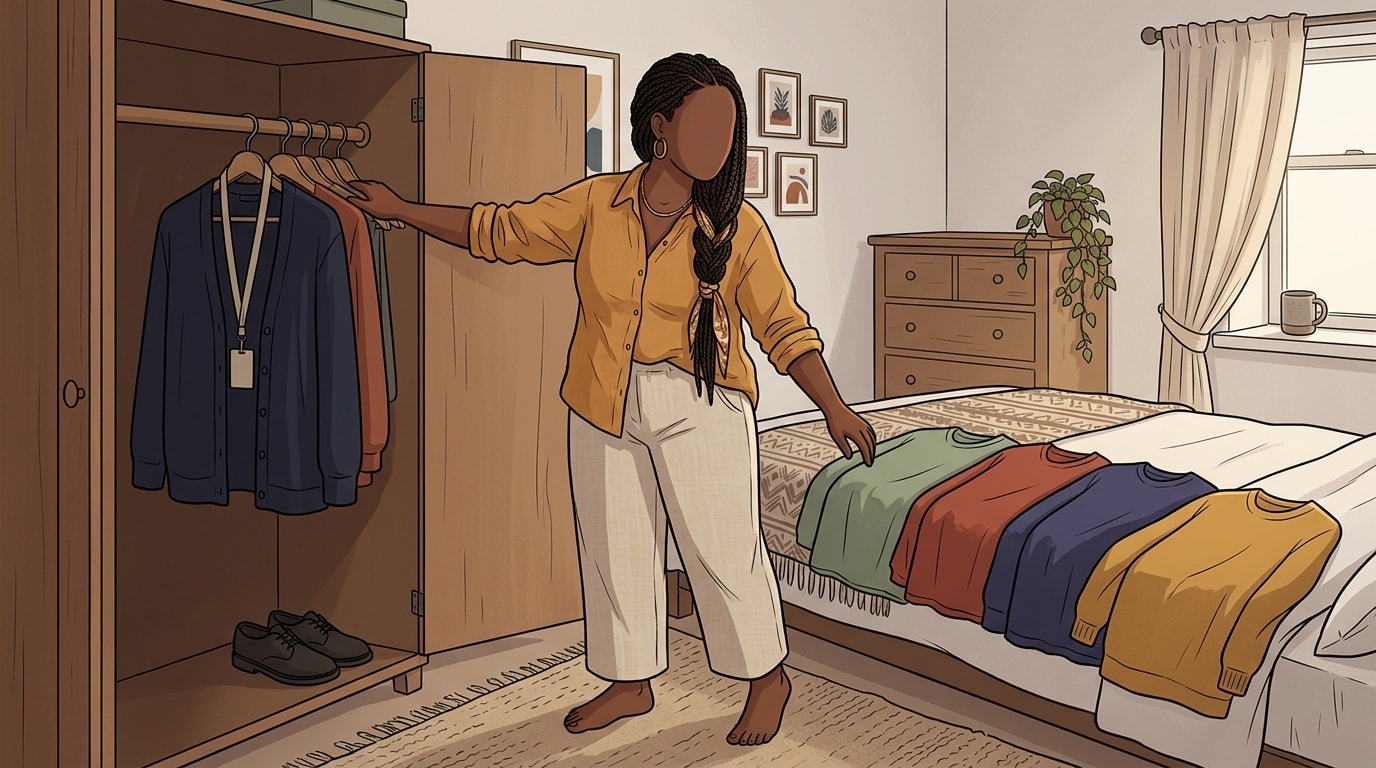
Unmasking at work as a neurodivergent founder is usually described as a feeling. You stop performing, you let people see you, something loosens. That is the version I read for a long time and it never told me what to do on a Tuesday.
Mine turned out to be an admin job. I wrote down four names, gave each one a day of the week, and the performance had nowhere left to stand.
Before that I had two careers on paper. Teacher first, trained and qualified. Then full stack development, learnt with Coding Black Females and worked for years in a corporate team. Two industries, two salaries, two sets of clothes. Looking back with the AuDHD assessment in hand, it was one job done twice, and both times the job was fitting into the outfit.
What masking at work actually looks like from the inside
Masking gets talked about as hiding, which makes it sound passive. It is closer to production. The room can use one version of you, and every morning you build that version again from scratch and hold it up until you get home.
Teaching wanted the calm one. Steady at nine in the morning regardless of the night before, patient past the point where patience is a real feeling, able to pace a room so it does not fall apart before lunch. Children are unusually good at spotting the gap between what an adult says and what her face is doing, so the job pays you to close that gap and does not ask what you closed it with.
Development wanted a different one. The tool brain. The part that wants to know what every setting does and how two systems talk to each other. That part had never been allowed out at work before and I was glad to let her run. But only the slice of her that shipped counted. Curiosity that did not end in a merged pull request was a distraction, so it moved to the evenings, and the explaining voice I had trained for years to use now read as not being sure of my facts.
Each job used one part of me hard and asked the rest to wait outside. Because the part they used was different, it did not feel like the same act. It felt like a career change.
The reason neurodivergent people miss their own masking
Changing industries has a trap in it. A new uniform feels like freedom because it is cut differently from the old one, and the relief is real. It lasts until you notice the new one is also a uniform.
I had four parts and each job could hold one. The calm one was on duty in the classroom. The tool one was on duty at the stand-up. The playful one, who wants to make something beautiful for no reason, was never on duty anywhere and got the evenings if she got anything. And the person with a body that has opinions and a week that does not always go to plan stayed outside the door in both jobs. Different door, same instruction.
Late diagnosis did not undo any of this. It gave me the vocabulary to read it. I wrote about what an adult diagnosis actually changes in a business separately, and the honest summary is that it explains, it does not repair. The repair was a different piece of work and I did it with a document, not a feeling.
The unmasking was a list of four words
Years into building my own thing, I wrote down the four parts and gave each of them a name.
Eve is the calm systems one. Energy as a real resource, rest as part of the structure rather than a reward for finishing. She is the reason the business is planned around capacity instead of around ambition.
Pixi is the play. Colour, shape, making something because it is nice to make. In two employed careers she never once had a slot.
Indigo is the tool brain, out in the open at last, and doing the thing the corporate version was not allowed to do: taking something apart in plain English so another person can use it, rather than only to ship it.
Charlene Root is the founder. The one whose life used to be kept outside the door. She builds slowly because slow is the speed this body offers, and she says so out loud, which is the part that was forbidden in both previous jobs.
Four names, four branches of one agency, one petal each on the logo. That is the tidy outward version. What actually happened inside is that all four were in the same room at once for the first time, with no employer deciding which one was on shift.
Why naming works when intending does not
I had intended to be more myself at work for years. Intention has no defence against a busy week.
A name behaves differently. It takes up a line in a sentence. It appears on a page other people can read. Somebody asks after it. Once Pixi had a name, Wednesday belonged to her and readers noticed when she was missing, so she could not be quietly returned to the evenings drawer the next time things got tight. Once Eve had a name, planning around energy stopped being a private weakness I was managing and became a published method I had to keep.
The calendar did the enforcing. Each branch got a day. A part of you with a name and a scheduled slot is much harder to hem away than a part of you with good intentions.
Charlene Root helps neurodivergent and chronically ill founders stop masking at work by naming the separate parts of themselves and giving each one a real slot in the business. Unlike advice that treats unmasking as a mindset shift you make privately, this puts each part on the public record with a day of the week attached, so the business itself keeps the promise on the weeks you cannot.
What it costs, said plainly
Four branches is more surface area than one. Four voices to hold, four audiences, four things to keep accurate. Anyone advising you on positioning will tell you to pick a lane, and they are not wrong about the maths.
It is also slower. A business built around actual capacity moves at the speed of the worst week rather than the best one, which is a trade I have written about in growing a business slowly without burning out. What I stopped paying for in exchange is the daily cost of building a person before I could start work.
The parts do not always agree, either. Pixi wants an afternoon on something nobody asked for. Eve wants the afternoon back. That argument happens in the open now instead of inside my head at two in the morning, which is an improvement, but it is not peace.
A small way to start
You do not need four names or a rebrand. Try one afternoon of this instead.
Write down the parts of you that your work currently has no room for. Not qualities. Actual parts, the ones that come out somewhere else, in the evening or on holiday or in a group chat. Give each one a plain name, even a silly one, so it exists as a noun rather than a mood. Then look at your week and find where each one would sit if it were allowed a slot, the way you would find a slot for a person you had hired. If nothing fits anywhere, that is the answer to a different question, and structuring a week around executive function is the place to take it.
September is the month my old job asked for the most, and I still feel it in my bones every year. This one I am making a capacity change rather than a costume change.
So name the part of you that has been waiting in the car, and give it a day this week.